Category Archives: AFL

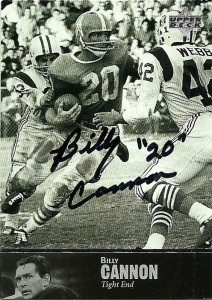
Cannon, Billy “Legend”

udlg97 cannonCard: Upper Deck Legends 1997
Acquired: 11/23/2012, Fiterman Autograph Event
Failure: TTM 2010, C/o Home

LSU’s sensational halfback and future Heisman Trophy winner, who led the Tigers to their first national championship, walked off the field of his final game for LSU to see a beaming madman in a prim suit standing in the end zone, named Bud Adams. With that Billy Cannon was signed with the AFL’s Houston Oilers in front of a televised national audience, effectively firing a warning shot towards the choppy waters the NFL was about to sail into. Before Cannon could get his legs under him in the upstart AFL, Pete Rozelle of the NFL and the Los Angeles Rams, (who drafted Cannon #1 overall in the NFL’s common draft,) sued him for breach of contract. You see Cannon had also signed a deal with the NFL in secret, but Adams, (who had arranged this whole scheme,) knew that if the NFL admitted that they had signed Cannon before his college eligibility had ended, would be essentially embarrassing themselves, based on the invalidity of their contract.

Billy Cannon gave the upstart league immediate viability and credibility as an alternative to the stodgy NFL. Along with quarterback George Blanda, and wide receivers Bill Groman, and Charlie Hennigan, Cannon led the Houston Oilers to the first two AFL championships in 1960, scoring on an 88 yard pass, in the team’s 24-16 victory over the LA Chargers. He’d then repeat again in 1961, scoring the only touchdown in the rematch between the two.  In that season he led the AFL in rushing with 948 yards (4.7 ypc), rushing for a team record 212 yards in one game, and overall with 2043 from scrimmage, but lost out to Blanda for the league MVP honors. In that season he set the league record for YFS in a game with 373 against the New York Titans, -a record that stood for almost 30 years, and had 5 TDs in that same game.  After the Oilers failed to win the championship game in 1963, Billy signed with the Oakland Raiders in 1964. It was there that Al Davis had the crazy idea of converting Cannon to a tight end. – And why not? With his soft hands, great speed, and size, Cannon was a perfect fit for the position and the downfield passing game that Davis employed. He played the next 5 seasons with the Raiders where he built an impressive resume at the position and won another title with the Raiders becoming one of the AFL’s greatest players at the position. Billy then played one final season with the Chiefs in 1970 and retired.  Cannon is one of only a handful (20) players who played the entire 10 year lifetime of the AFL in the league.

Billy has had some missteps since his career ended, and got in deep with the wrong people. In order to catch up he half-cooked up a counterfeiting scheme, and was sent to jail in 1983. After being released for good behavior, he went back to work in the medical field as a dentist, but had a difficult time finding work. Cannon was reviled now by the people who used to admire him who now would rather celebrate at seeing him fall further. It’d be in the most unlikeliest of places that Cannon, “The Legend” found his redemption. The prison system had need for a dentist, and Cannon came in and cleaned up the LSP dental department. In fact the Warden liked Billy’s work so much, that he promoted him to run the whole medical wing. It was in this perhaps, that Billy saw a glimmer of happiness in his work, and slowly over the next few years, took baby steps into the world again and began to make appearances at LSU functions. With time all wounds heal, and Billy was again praised for those svelte moves that earned him a place in school history for a play simply known as “The Punt Return”.  Cannon still works at the prison today and is referred to by the inmates simply as “Legend”.  He also enjoys raising and breeding horses.  Billy Cannon is the only player to have been inducted into the College Football Hall of Fame twice. He earned the recognition in 1983 but it was taken away due to his conviction, and then again was inducted in 2008. His number has also been retired by LSU.

G 133     Rush  602     Yds   2455     Avg   4.1    Td  17   Lg  64
Rec  236    Yds 3656   Avg  15.5     Td  47      Lg  88
Kr  67   Yds  1704      Avg  25.4    Td 1   Lg  88
Pr  14      Yds  178      Avg 12.7      Td 0   Lg  51

The punt return: http://www.youtube.com/watch?v=GIHdlAg4Uic

Griese, Bob

Card: Pro Set 1990
Acquired: TTM 2012, C/o Home
Sent: 2/22     Received: 12/8   (290 days)

At 290 days, -a wait well worth it I’d say, as another HoF headliner joins the club, in the name of Bob Griese.  I had given up on Bob, and when I got the envelope back I must admit that I was surprised and pleased with his response. Bob had an impressive career at Purdue for the Boilermakers playing football, basketball, and baseball. He’d play quarterback for the Boilermakers from 1963-1966. It wasn’t until his Sophomore season in 1964 that Bob took the reins and start as the team’s quarterback, punter, and kicker.  In 1965 he led Purdue to a 25-21 upset of #1 ranked Notre Dame. As a starter he’d post a 22-7-1 record. In his senior season, Griese led the team to a Rose Bowl victory over USC 14-13 in what is considered the school’s signature victory. Bob was a smart QB and what he couldn’t do with his arm, he’d frequently do with his legs. His final numbers set precedence for the school’s modern era quarterbacks such as Jim Everett and Drew Brees to break.

Griese was drafted in the first round of the 1967 AFL draft by the Miami Dolphins.  He’d have 15 TDs passing,  2005 yards, and 157 yards rushing his rookie season- good enough to earn All-Star Honors, despite starting the season originally on the bench, and for an expansion franchise. He’d grab All-Star honors the next season as well with 21 TD passes. Still, the team continued to struggle with winning, and Griese was becoming known as a good quarterback on a bad team. Don Shula was brought in to coach the team in 1970, and Griese guided the team to a 10-4 record. At the conclusion of the season, Bob was named MVP of the league, but the team fell in Super Bowl VI against the Dallas Cowboys. The Dolphins came back with a vengeance the next season, and steamrolled opponents in 1972, going 14-0. While Earl Morral came in to replace Griese during the season due to injury, the team returned to Bob in the playoffs to help them win the Super Bowl. Griese capped off Super Bowl VIII as well with a victory over the Minnesota Vikings.  By 1977 Bob began wearing those iconic black rimmed glasses on the field, but new powers began to rise in the AFC in the Central division, with the indomitable Steel Curtain in Pittsburgh and the Houston Oilers ground game led by Earl Campbell. While Griese continued to post good numbers and the Dolphins posted solid records, they wouldn’t return to the Super Bowl again.  After the 1980 season, Griese retired. The Dolphins had David Woodley waiting in the wings, and he’d guide the team to another Super Bowl loss, before Dan Marino took the reins in 1983 and rewrote all the record books for the franchise.

Griese kept close to the game and did color commentary for many years at the college level. He also handled color for the Dolphins’ preseason games as well. He’s enjoying now full retirement, in Florida and was inducted into the Pro Football HoF in 1990, the College Football HoF in 1984, the Dolphins Honor Roll, and had his number retired by the franchise as well.

G/Gs 161/151     Att 3429     Comp 1926         Yds 25092      Pct 56.2%      
Td  192   Int 172    Rat 77.3  |

Rush 261   Yds 994    Avg  3.8     Td 7     Lg 35

Gabriel, Roman (1940-2024)

Cards: ProSet WLAF 1991, ProSet WLAF Helmet 1991, ProSet 1991, UD Legends 2005
Acquired:  TTM 2011, C/o RG Enterprises
Sent: 11/9     Received:  11/23  (14  days)

Embarrassingly I am a fan who grew up after the Roman Gabriel era, and my memories of him is neither as quarterback of the Los Angeles Rams or Philadelphia Eagles, but rather as head coach of the woeful Raleigh-Durham Skyhawks from the WLAF circa 1991.

These were the only cards I had in my collection of him, and after being informed of his stiff signing fee of $10 per signature, I waited sometime before contacting him a second time for an autograph. He kindly enclosed an Upper Deck legends card from 2005 as well, and thanked me for writing.

An all-around athlete for NC State, Roman Gabriel was drafted by the Los Angeles Rams in 1962 as the second overall pick. (He was also chosen in the AFL draft by the Oakland Raiders.) Choosing to sign with the Rams, Gabriel went on to become one of the most successful Asian-Americans in American Football (Philipino). Once he was made the starting quarterback in 1966 he went on to rewrite many of the passing records for the Rams franchise.  

After flirting with the AFL and signing with the Raiders,  Roman decided to stay put with the signing of head coach George Allen. His patience was rewarded, as Gabriel went on to be named the NFL’s MVP in 1969.

As knee and shoulder injuries began to take their toll on Gabriel, he’d be traded to the Philadelphia Eagles in 1973 and help right the ship of the woeful Eagles franchise and earn Comeback Player of the Year Honors.

Over the last few seasons he’d play sparingly as a backup quarterback until his retirement after the 1977 season. Gabriel’s strongest attributes as a QB were his powerful arm and his excellent decision making abilities. He’d finish his career with an 84-67-7 record.

Roman (post playing days) remained active in sports and dabbled in acting. Besides owning some car dealerships, he worked as a color commentator and served as a head coach.

In this capacity among his notable stops were that Gabriel was head coach at Cal Poly Ponoma, offensive coordinator of the USFL Boston Breakers in 1983,  quarterbacks coach of the Arizona Wranglers in 1984, and finally at his gruesome stop as first- general manager and then finally as head coach of the WLAF Raleigh-Durham Skyhawks.

Unfortunately things didn’t work out for Gabriel the way he had hoped as the Skyhawks finished 0-10 in their only season in the league.  From then he diversified his interests and was deeply committed to charitable causes.

He was inducted into the College Football Hall of Fame in 1989, and the Hall of Very Good in 2015.

Roman was a voracious signing up until his final days, and I had just finished putting a letter together for another request.

ATTCPDYDSPCTTDINTRAT
449823662944452.620114974.3
RUSHYDSAVGTDLG
35813043.63039

EPITAPH:

4/20/2024- Roman Gabriel passed away peacefully at the age of 83, of natural causes.