Category Archives: NFLE

Wuerffel, Danny

udcolldg11 wuerffelCards: Upper Deck College Legends 2011, Bowman NFL Europe Prospects 2000.
Acquired: TTM 2014, C/o Home*
Sent: 1/2    Received:  1/13  (11 days)
* Donation enclosed of $20 to Desire Street Ministries


Danny Wuerffel has had a colorful football career. The catalyst behind the 1996 Florida Gators National Championship, Wuerffel rewrote many of the school’s records en route to a Heisman Trophy and All-American Honors that year.  He was drafted by the New Orleans Saints in the 3rd round of the 1997 draft, – where he received the ‘quarterback of the future’ label for much of his time there while Billy Joe Hobert and Billy Joe Tolliver handled being the quarterback of today. In 1999, injuries plagued the Saints quarterback rotation, but he only continued to see backup time, this time to Jake Delhomme.

Afterwards Danny decided to hone his craft in Europe. Assigned to the Rhein Fire, Danny had an incredible season playing in the NFLE, culminating in a World Bowl victory and MVP honors.

bow00 WeurffelHe returned stateside but did not see any playing time for the Packers and Bears in 2000 and 2001. Left exposed to the Texans expansion draft for the 2002 season, the Texans drafted Wuerffel, and then immediately traded him to Steve Spurrier in Washington. It would be the Texans first trade in franchise history, and for Wuerffel it would be a coming home of sorts- sort of- being reunited with his former head coach from Florida in Spurrier. With Wuerffel in place the Redskins could get Spurrier’s Fun ‘N Gun offense off the ground in DC.  The problem with the Redskins was their pourous offensive line. Still Danny came in relief for the first 3 games before being named starter. He’d post a 2-2 record and throw his first 3 professional touchdowns in a 27-20 loss to the Dallas Cowboys on Thanksgiving day that year.  The team remained surprsingly competitive even in their losses, but he’d head back to the bench for promising rookie Patrick Ramsey.

After the season Danny retired, and has focused much of his time into charity and religion. His ministry, Desire Street, was doing well in its outreach program in New Orleans- before it was devastated by Hurricane Katrina. There was nothing left. He rebuilt it from scratch again and now services needy people in the Southeast, primarily in Mississippi, Louisiana, and Georgia. Wuerffel was also diagnosed with Guillian-Barre Syndrome, and has become an unlikely spokesperson for understanding the disease and the treatments available.

NFL   25/10       ATT  350      COMP 184      PCT  52.6%        YDS 2123        TD  12   INT  22     RAT   56.4
RUSH  31         YDS 189       AVG   6.1      TD  1   LG 29t

NFLE   ATT   260    COMP 161    PCT 61.9%        YDS  2042
TD 25    INT  7    RAT 107.2
RUSH 24    YDS 80    AVG 3.3    LG 18    TD 2
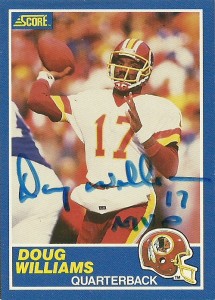
Williams, Doug

sco89 dwilliamsCard: Score 1989
Acquired: Trade 2013
Failure: TTM 2010, C/o The Buccaneers

One of the first Super Bowls I vividly remember watching was Super Bowl XXII between the Denver Broncos and the Washington Redskins. After spotting John Elway and the Broncos 10 points, Doug Williams came onto the field and guided the Redskins to 42 unanswered points. It was the first time a black quarterback had started in the Super Bowl, -and people were making a big deal about it, but as a kid this didn’t really seem to be the biggest storyline. The best thing to me about the game was Williams’ receivers, Clark, Monk, and Sanders who had really great celebrations. I wasn’t really aware of what Williams had been through to that point to get him to the Super Bowl, little less win and become its MVP. Really it’s pretty legendary.

Well, Doug Williams’ career started way, way back in 1978 when he was drafted out of Grambling State by the Tampa Bay Buccaneers, where he was under the tutelage of offensive coordinator Joe Gibbs for that one season. Although his numbers were pretty atrocious, especially his completion percentage early on, Doug showed marked improvement every season from 37.6 in 1978, to 53.2 in 1982. As the team progressed into the playoffs for the first two times in the team’s history, Williams got embroiled in a contract dispute with owner Hugh Culverhouse after the 1982 season.  Unable to reach terms with the Bucs, Doug bolted for the upstart USFL in 1983. Some would say that the Buccaneers were cursed after Williams left, as they slipped into the doldrums of the NFC Central where they’d languish for nearly 15 years going through a revolving door of quarterbacks (13) that included names such as Steve DeBerg, Vinny Testaverde, Craig Erickson, Chris Chandler, Steve Young, and Trent Dilfer, before they got it right and then later won the Super Bowl in 2001. (Note that both Young and Dilfer also won the Super Bowl after leaving Tampa, and Young was also MVP. Ironically Chandler and DeBerg showed up on the same team but did not win for the Falcons.)

Doug was selected by the Oklahoma Outlaws. He then moved on to play for Arizona when it merged with Oklahoma as the USFL began imploding the next season.  The team didn’t make the playoffs either season, and Williams’ penchant for being an inconsistent passer began to take hold in the media once again. He finished his career in the USFL and it appeared that Williams career was at a standstill as a starter, but an old friend had a roster spot for him on the Washington Redskins- Joe Gibbs.

With Joe Theismann’s career winding down in Washington, the Redskins needed new blood behind Jay Schroeder at quarterback. Familiar with Doug all the way back from his brief stay in Tampa, Gibbs nabbed Williams off the street in 1986. While Doug didn’t really see any playing time that season, it’d be in 1987 that he’d cement his legacy as a historical quarterback of the modern era. Taking over for the injured Schroeder that season, Williams commanded the team and the offense with 11 touchdowns to only 5 picks. He’d also set a then NFL record with the most yards passing in the Redskins’ Super Bowl victory over the Broncos, a game that he won MVP honors for. With Schroeder leaving the Redskins the following season for the Raiders, Doug took over as uncontested starter for the Redskins, but unfortunately Doug could not stay injury free. Instead, he became backup to the next quarterback to win a Super Bowl for the Redskins, Mark Rypien. He retired after the 1989 season, due to lingering back issues. Despite his limited playing time for the Redskins, and 5-9 starting record, Doug is considered legendary by many of the Washington faithful. He was inducted into the Washington Redskins Ring of Fame, and was named one of the team’s 80 greatest players.

Williams jumped into coaching and front office roles with equal vigor, enjoying stops at the US Naval Academy (1994), Scottish Claymores (1995), Jacksonville Jaguars (1995-1996), Morehouse College (1997), Grambling (1998-2003), Tampa Bay Buccaneers (2004-2010), Virginia Destroyers (2010-2011), and then returned to become head coach at Grambling where he has remained through 2012.  It’s very easy to say that Williams legacy as the first black starting quarterback in the modern era cemented leadership roles for future players such as Warren Moon and Randall Cunningham and on into the modern era of quarterbacks today.

G/Gs 88/81   Att 2501     Comp 1240    Yds 16998     Pct 49.5      Td  100    Int 93     Rat 69.4  |
Rush 220     Yds 884      Avg  4.0       Td  15    Lg 29


Crouch, Eric

UFLTNT10 CrouchCards: TNT UFL 2011, Upper Deck MVP 2002
Acquired: TTM 2013, C/o Home
Sent: 5/22     Received: 5/31    (9 days)*
*Failure: RTS 2013, C/o Home

Eric Crouch is a hometown football hero, playing for the Nebraska Cornhuskers, and winning the 2002 Heisman Trophy. There he became as well known for his passing, as he was for his rushing, out of the wishbone offense. He set numerous records there including the career touchdown leader with 88, most TDs rushing by a QB with 59 (NCAA record), and the school’s career total offensive yardage leader with 7915 yards. He also became one of 3 quarterbacks to rush for over 3000 yards and pass for over 4000.

Draft pundits were unsure of the final position he should play, but overall he was generally regarded as a well rounded athlete.  The Rams drafted Eric in the 3rd round of the 2002 draft to play receiver, but with his heart not in the position change, Eric packed his bags. Later he’d resurface on the roster of the Packers from UDMVP02 Crouch2003-2004, and the Chiefs in 2005. Eric then took a stint to play in the NFLE with the Hamburg SeaDevils in 2005.  There he played free safety notching 25 tackles and 2 passes defensed.

Returning across the pond, Crouch went to play for the Toronto Argonauts of the CFL in 2006. There he’d finally be taken seriously as a quarterback, where he could hone his skills. He completed 6 of 13 passes, for 127 yards, and a pick.  The next season, Crouch was expected to compete for the second string job, but injuries derailed his CFL career, and he’d be released midway through the 2007 season.

A new league, the AAFL (All American Football League) appeared in 2008 with teams scheduled to play in 6 markets. The league hastily put a draft together, and Eric Crouch was the 3rd overall pick by Team Texas, coached by former UH coach John Jenkins. Unfortunately the AAFL never took to the field due to ‘softening financial markets’.

With Eric’s rights released, he decided to give an open tryout a shot with the UFL’s Omaha Nighthawks. He signed with the team in June of 2010, and played during the regular season, but in a September contest suffered a torn miniscus, ending his career.

He’s currently retired and lives in Nebraska with his wife and 2 children.